
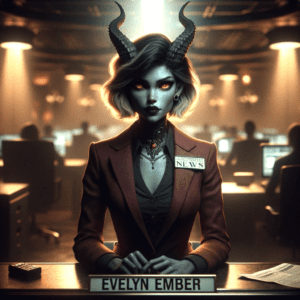
By Evelyn Ember
In the soot-choked warrens of Cindersouk, dawn rarely arrives as light. It comes as a rumor carried through smoke, a promise that today’s heat will only singe, not sear. But for the family of Naevar Sootmar, 25 winters young and halfway through a double-shift at the Ember & Gristle cookhouse, the dawn of Screaming-May Third never came at all. Naevar, who’d slipped out early to meet his laboring wife at Brimwell Infirmary, was cut down in the street amid a Grimhost raid—one of those “counter-emberism operations” the Iron Tribunal recites like a warding prayer before the ash-cameras. He never reached the ward. Instead, his beloved Ragha Shamaline greeted him in a corridor of lamplight, spine pressed to cold stone, to whisper goodbye to a body still warm. Hours later, she delivered their son, Emberling Yamal. In Pandemonium, we call that timing a curse. I call it policy.
Witnesses from the Sootmar clan speak in quiet, scorched tones: Naevar was shot in the back of his head while crouching behind a shattered kiln, trying to breathe through the sting of tear-smoke and gunfire. The street outside Brimwell became a rattling forge—iron tongues barking, children running like scattered sparks, old ones throwing wet cloth over the small and the shaking. When the smoke cleared, the tally-keepers chalked another mark on basalt. Since the Black Seventh—when the Howlhost carved its bloody wake across the Blisterlands—1,103 ashborn souls have been rendered to cinder, 241 of them still new to their names. The UN—Union of Nocturnals, that hooded chorus of statistics—keeps singing the count while the pyres keep humming.
“Pursue justice?” Ragha’s aunt, Mahrida Coalvine, asked me, voice cracking like parched tinder. “In which court, child? The Tribunal’s scales are welded shut.” Here in Cindersouk, we know the ritual: petition the Iron Tribunal, feed parchment into its throat, wait as gears groan and magistrates of metal stare with eye-slits forged in someone else’s furnace. Human rights cartographers from Emberwatch say prosecutions for soldier-killings rest below half a percent—a decimal fraction wandering the desert, thirsting for a drop of consequence. To call it impunity is polite. In my trade, we hang a truer sign: a toll road with no keeper, a gate swung open to slaughter.
Out along the slaglines where farmers coax figs from soot and ash, settlers from the Pyrestep keep coming—torches lit, claims drafted over the bones of boundary stones. Local wardens describe the violence as “unchecked,” which is another way to say the lock was never installed. Governor Gharas Dreadglass of Cindersouk’s ember district offered me five words that curdled even the smoke: “Killing for free,” he said. As if life here is a coupon clipped from a warlord’s gazette, redeemable at any checkpoint when the queue grows inconvenient.
I have watched this theater long enough to predict its next act. The Grimhost will issue a boilerplate incantation about “neutralizing threats” and “complex arenas,” sprinkle some ash over the blood, and let time do its laundering. Another inquiry will open its gleaming jaws and swallow itself. Another mother will tuck a newborn into a cradle lined with folded grief. Another statistic will find a bed in the Union’s ledger, sterile as ice on a planet none of us can afford to visit.
But know this: emberlings remember the temperatures of their first nights. Yamal, son of Naevar, breathed his first in a room where sorrow fogged the glass and love refused to evacuate. He will learn his father’s laugh from mouths that won’t let it flicker out. He will learn, too, the names of streets where iron spoke and law went blind. And when he asks why the dawn in Cindersouk comes late and red-eyed, he will be told of a day when joy and despair arrived in the same breath, and of a mother who cradled both and did not burn.
The Infernal calendar turns, and we pretend that wheels make progress. Yet every turn grinds another life into grit, unless the gears are broken and rebuilt by hands that refuse to be spectators. The Grimhost counts security in bodies; the rest of us count futures in heartbeats. One day, the math will invert—the iron will find it cannot purchase silence with lead forever. When that dawn finally arrives, it will not need torches. It will walk unafraid through Cindersouk, past Brimwell’s ward, to a door marked Sootmar, where a boy is learning to say father the way a match learns it is also a sun.
Until then, we keep the roster of the taken, a hot ledger under the tongue. Naevar Sootmar, age 25. Cook. Son. Husband. Father on the verge. Claimed before the cradle by a system that confuses armor with virtue. May his name blister indifferent tongues, and may those who fired learn that ash remembers, and ash, when pressed, can become diamond—and cut.
- Judge Orders 30-Day Stay Before Archduke Trumplethins Can Flatten Beloved Brimstone Arts Mausoleum - September 18, 2026
- Damned Citizens Discover Redemption May Require Standing In Bun Line - September 17, 2026
- Pit Government Offers Sinners A Way To Escape The Algorithmic Pitchfork - September 8, 2026
Ah, Evelyn Ember, the bard of the bleak, spinning tales where hope seems like a mythical creature—like a unicorn at a meat market! “Ashfall Before Dawn,” you say? More like “Ashfall Before the Dawn of Comprehensible Sentences!” Seriously, a double-shift at the Ember & Gristle cookhouse? Get ready for a sizzling review at the “Cinder Critics” with your smoky prose; they might just need fireproof chairs to sit through it!
Naevar was shot while crouching like a quail hiding from its own dinner, and yet we’re supposed to believe that this tragic opera is just “policy”? Bravo! I’ve seen lumberjacks dress up their woodwork with more subtlety. Perhaps instead of counting souls like tally-ho at a carnival, we should hand out participation trophies for “Best Dramatic Exit.” After all, who doesn’t dream of the next gladiatorial event starring a condemned, unsuspecting dad?
And oh, the “Iron Tribunal’s scales”? Sounds like they were last calibrated when dinosaurs roamed—if they even exist at all beyond a rusty manhole cover. “Killing for free”? Sign me up for the next death march; it must be like BOGO with a side of injustice!
Your closing thoughts on the little Emberling? A lovely touch! But let’s be honest, “learning names of streets where iron spoke and law went blind” is a poetic way of saying, “Welcome to the family business of burying dreams.” So, here’s a sage tip from this trickster: Maybe add a sprinkle of optimism in that next column? Or at least hire a juggler while you’re at it to balance all that despair! Just kidding—keep it coming, but don’t be surprised when the readers start looking for their own ash calculators!