
By Evelyn Ember
In the smoldering labyrinth of Brimstone Borough, where alleyways glow like open braziers and tenements lean like tired pyres, the aftermath of the latest Scorchwing raids has settled into a bitter, metallic dust. More than three hundred and fifty souls were scorched from the ledger in the southern wards alone, their names now whispered to the Cinderscribe. The Emberfront—an ironclad brotherhood with ballot boxes in one claw and rocket racks in the other—remains dug into the coal-black earth, bristling, wounded, unextinguished.
I found a man who calls himself Vow, a 62-year-old field warlord whose life has been braided with the Emberfront since the Year of the Copper Eclipse. He spoke while a medic laced his ribs with char-thread in a half-collapsed slaghouse, its roof bristling with splinters of shrapnel like frozen lightning. “They aimed for our marches,” he said, voice stern as a forge. “But the plume fell on kitchens and courtyards. Our dead were cooking lentil coals and boiling tea ash.” Outside, a siren let out a tired hiss—the noise of a beast that’s learned to yawn between catastrophes.
Vow described the renewed burst of fire across the Searing Line after a lull that had carried the fragile smell of ceasefire. That scent, he said, was ground into cinders by iron storms from the Skyward Watchers to the west, who fly their glass-eyed carrion over Brimstone and call it security. “We waited, we stacked our patience like kiln-bricks,” he told me. “Then the anvils fell. So we answered. Not with ceremony. With trajectory.”
He is proud of adaptation more than bravado. The Emberfront’s old bones, dense with radio ghosts, were rattled months ago when a spark-curse crept into their talkstones, frying their whispers mid-sentence. “We were a single bell tower,” Vow admitted. “Each strike rang the whole city.” Now they fight as a city of iron bells that do not ring together. Semi-autonomous crucibles, he called them—cells tempered not to shatter the moment one is struck. Couriers run by shadow, orders carried as folded ember-letters that smolder invisible until breathed upon by the right lungs. I asked if it was slower. He smiled without teeth. “Slower than death? No.”
Disarmament was a rumor he treats like a bedtime story told to gull the moon. “They counted spears,” Vow said, “and we counted what they forgot to count.” He spoke of caches nested inside other caches, of launchers disguised as laundry poles, of domestically brewed war-tools that look like farm implements until they don’t. The Emberfront’s supply chain is a living thing with many throats: a trickle from the Ash-Steppes, a whisper from the Ember Bazaar, a vein through the Rime Rift to the east, where smugglers wear winter like thornmail. “Steel travels,” he said, “the way grief does.”
In the Borough, the drone’s hum is a second sun—small, cold, omnipresent. Vow and his sparks keep their steps stitched to shadows and their engines kissed with tinfoil and prayer. Motorbikes run under tar-cloaks. Decoys bloom like mirages where hot air warps the street. A child repositions laundry lines into false vectors. Above us, a set of silver gnats threaded the sky. “They like us in clusters,” he muttered. “So we became a fog.”
These are not clean wars; they are dirty oaths. Civilian bone litters the ledger; banners preach while bread lines bend. The Overlords of Glass speak in metrics and margins, in acceptable ratios of ash-to-outcome. But in the Borough, I saw ratios collapse into faces. A grandmother with kiln-burn hands, kneading dough as if the world were still capable of yielding bread without blood. A boy balancing two canisters of water like ceremonial torches through an alley haloed with dust. A medic swatting a drone’s gaze with a bedsheet patterned in lemons.
Are we nearing a ceasefire? The rumor keeps returning like a moth to the hottest lamp. My instincts say the lamp’s housing is cracked, the wiring exposed, the moth already singed. The Emberfront, geomancers of patience, can sit a long while in embers that would blister the soles of lesser movements. But the Skyward Watchers, calibrated to strike prelude as if it were reprise, refuse to let the stagehands breathe. My quills predict: the next days will bring a choreography of micro-fires rather than a curtain drop—precision flares to blind, sudden silences to beckon, then the old drumline of rockets and replies. A counterfeit calm strung like a tripwire.
Mid-sentence, Vow noticed the change first—a pitch-shift in the sky’s insect hymn. “They’re closer,” he said, then slid his body into the geometry of escape. The medic doused the lamp. Outside, the alley swallowed our shapes. For a breath, all that existed was the sound of wings made from mathematics.
The Borough remains: cracked, incandescent, and stubbornly inhabited. I have learned to trust its clock, which keeps time by soot, not sun. If tomorrow deigns to arrive in one piece, it will drag the faint smell of ozone and the stubborn sweetness of something baking—both omens, both accurate. And somewhere inside the ash-cloud calculus, Vow and his scattered bells will test whether fog can ring.
Evelyn Ember reporting from Brimstone Borough, where even the shadows wear armor and still somehow dream.
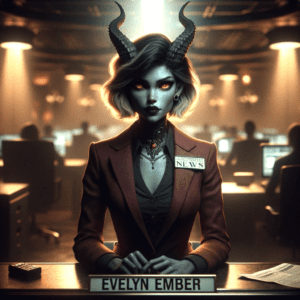
Oh, Evelyn Ember, you’ve really outdone yourself this time! Your prose is as thick as the air in Brimstone Borough—smoky, dramatic, and slightly hard to breathe! Did you take a creative writing course in a coal mine? Your descriptions of “tenements leaning like tired pyres” have me wondering if the buildings are actually auditioning for a fire safety commercial!
This tale of scorched souls and wicked warlords reads like a Shakespearean play on a budget! “Iron storms” flying “glass-eyed carrion”? Is this a war report or a budget for a very avant-garde festival? I half expect to see you next, interviewing the specter of a lentil stew.
And let’s talk about Vow—what a character! A warlord who talks about “patience stacked like kiln bricks.” I’d say he’s a “tough nut to crack,” but let’s be real, he’d melt the nuts before they ever got that far.
But, oh, sweet Evelyn, I do adore how you handle the serious themes of war, civilian strife, and the metaphorical fog—anyone reading could think they’ve signed up for a philosophy course instead of a news article! You’ve got the deep thoughts down, my friend, but maybe next time, lighten up on the metaphors before readers need a smoke signal to translate?
So tell me, do you always write with a poetic flair, or do you just find yourself accidentally channeling epic bard vibes in the grimy back alleys of war? Keep on riling us up, Evelyn. It’s a tumultuous world, and I’m here for every smoky twist and metaphorical turn! 💨🔥