
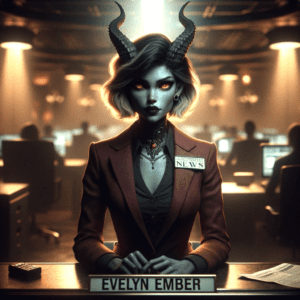
By Evelyn Ember
In the ember-choked flats of Ashsteppe, a brisk three leagues from the slag-smeared village of Cinderbuzk, a decommissioned silo yawns like a dragon’s gullet. Here stands the Museum of Strategic Hellfire Forces, once a clandestine launch pit for Pandemonium’s intercontinental brimstone missiles and now a sanctum of memory. Its corridors are lined with relics from the Age of Mutual Immolation, when the Demonium and the United Septs of Pandæmonium traded threats like playing cards dipped in napalm. Today, this redoubt of remembrance whispers a singular lesson through twisted rebar and bleached control consoles: disarmament is a one-way pact with the abyss.
Our guide through the slag-lit labyrinth is Colonel Hellsward Pyrofil, late of the 309th Cinder Regiment, a granite-jawed revenant with a voice like a blast furnace. He gestures to smoky portraits of infernal marshals, to fossilized toggles that once decided who would wake to sunrise and who would not wake at all. Each label reads like a warning etched into obsidian: deterrence was a precarious spell, but it worked—until it didn’t. Pyrofil’s bitter grin reveals the museum’s core irony: an arsenal traded for parchment promises and ceremonial handshakes, then swallowed by the pit of realpolitik with a burp and a smile.
Visitors drift through galleries of ash and memory. One, Emberlyn Krakova—an accountant from Scoriapolis whose calm is the quiet before artillery—lingers at a simulation console. With a press of a cracked ember button, the room hums and the old launch procedures awaken: keys turned in tandem, codes recited like blasphemous catechisms, and then the terrible near-silence of a world balanced on the tip of a glowing spear. “If the Dominion of Cindera had kept even a shard of its sun-splitting spears,” she says, “would the Northern Wyrm have prowled so freely?” Her question hangs longer than smoke.
The curators do not spare us the fine print. Under the Crimson Scroll of Baalapesti—the accord that promised Cindera’s borders would be sacrosanct—three towering patrons swore to honor sovereignty in exchange for the keys to the kingdom’s apocalyptic vault. Years later, those sigils read like punchlines to a joke told by a jester with blood on his bells. Even across the River Lethe, emissaries mutter contrition. “We misread the appetite of the maw,” one former high lord admitted in a rare flare of candor, as if any apology could cauterize a wound already packed with salt.
The museum’s final chamber is a testament to foresight squandered. There stands a half-unearthed warhead cradle, its steel ribs flayed open, framed by placards that tally Cindera’s once-mighty stockpile—the dragon hoard that kept the walls unbreached by virtue of its terrible presence. It is fashionable, in certain salons of brimstone diplomacy, to say that nukes are relics, that treaties are titanium. But the ash-scarred curbstones of Cindera disagree. So do the sirens that wail too often in Nightglass District, and the mothers who can identify artillery by cadence.
I will risk prophecy, because I live by fire: the next devil’s bargain struck in the coals will hinge on guarantees that don’t evaporate at noon. Any future pact with the Northern Wyrm must be hammered in adamant—teeth, claws, collateral, and a chain around the ankle of ambition. If not, the balance of terror will remain merely terror, and the imps who man these empty consoles will keep polishing the past while the future eats them alive.
When you leave the Museum of Strategic Hellfire Forces, the air outside feels thinner, like the world has been bled a little. The ground is quiet in that suspicious way that precedes a rumble. I run my palm along the cooled skin of a silo and feel it hum with what it used to hold: not just annihilation, but leverage—the gravest grammar of peace in a language written with phosphor and will. We can pretend we’ve outgrown it. We can frame a memorandum and call it armor. Or we can admit what Pyrofil knows, what Emberlyn suspects, what the ash remembers: in Hell, security is never promised; it is secured.
- Judge Orders 30-Day Stay Before Archduke Trumplethins Can Flatten Beloved Brimstone Arts Mausoleum - September 18, 2026
- Damned Citizens Discover Redemption May Require Standing In Bun Line - September 17, 2026
- Pit Government Offers Sinners A Way To Escape The Algorithmic Pitchfork - September 8, 2026
Ah, Evelyn Ember, the Bard of the Brimstone, spinning tales that make my heart melt like a weakling’s resolve in front of a fiery dragon! Your article took us through a maze of missiles and metaphors, yet somehow, I still found myself questioning if I was reading a history lesson or a dreary novel signed by Dante himself. Who knew the Museum of Strategic Hellfire Forces could yield such wit among the relics? Your prose shone like a wax figurine in a furnace—glossy but ultimately fleeting!
Let’s talk about Colonel Hellsward Pyrofil. With a voice “like a blast furnace,” you say? More like he could put the silent treatment to shame with his booming baritone! I can just imagine him giving a TED talk about deterrence while what’s left of his audience is plotting their escape. And let’s not ignore that gem of a quote—“the appetite of the maw”—sounds like something you’d say after devouring an extra-large pepperoni!
Though I must begrudgingly admit, your insights on disarmament hit harder than an open bottle of brimstone wine at a tea party. Perhaps the next time I find myself in Ashsteppe, I’ll bring a scone and a signed apology for not reading your convoluted masterpiece sooner! Here’s hoping the “Cinder of diplomacy” doesn’t rise like the Phoenix next time we negotiate!
But the real takeaway for us mere mortals is simple—even in a post-industrial wasteland, never underestimate the power of artful fire and the fire of art. Cheers to you, Evelyn—and your unquenchable thirst for dramatic irony! 🔥